
Formal rules of procedure or etiquette
etiquette, system of rules and conventions that regulate social and professional behaviour. In any social unit there are accepted rules of behaviour upheld and enforced by legal codes; there are also norms of behaviour mandated by custom and enforced by group pressure aussie casino no deposit bonus. An offender faces no formal trial or sentence for breach of etiquette; the penalty lies in the disapproval of other members of the group. Regardless of its level of material culture, any highly stratified society will possess an etiquette in which every person knows the behaviour expected from him toward others and from others toward himself.
The list could go on, but you can already see the pattern.Not only do these experiences drain your mood and make you feel insignificant, there is something even more important at play.Do you want me to spell it out?
In Britain standards of conduct were greatly affected by the publication in the 16th century of certain Italian works known as courtesy books. Probably the most influential of these was Baldassare Castiglione’s Il libro del cortegiano (1528; The Book of Courtesy, 1561). Further elaborations by English authorities—e.g., Richard Brathwaite’s The English Gentleman and Description of a Good Wife—arrived in colonial America with passengers of the “Mayflower.” These British imports were soon followed by such indigenous products as the manual for parents entitled School of Good Manners (attributed to Eleazar Moody, 1715).
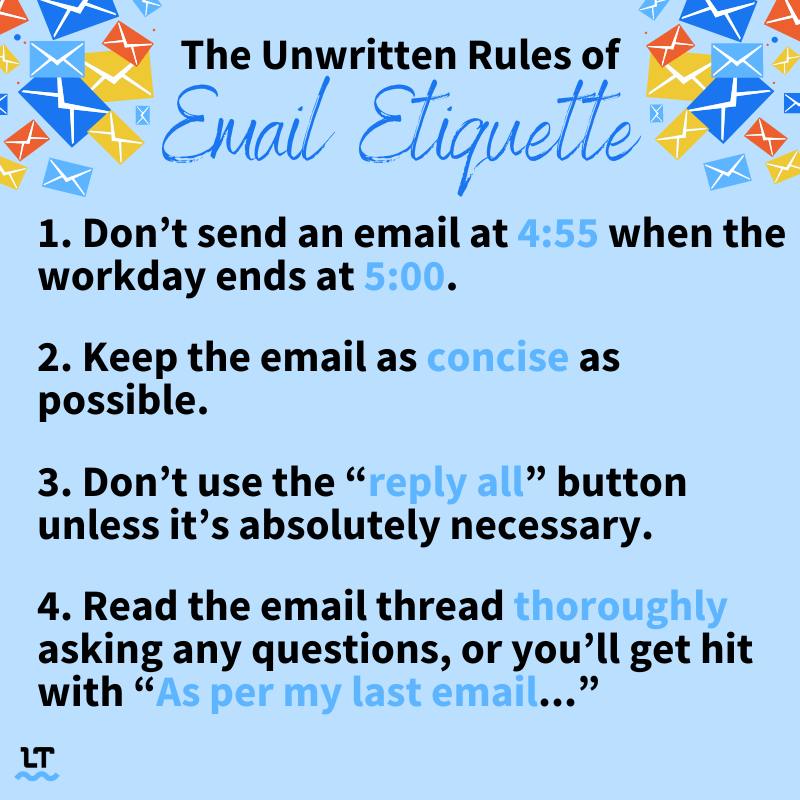
10 golden rules of email etiquette
It’s a good practice to write the contents of your email first to prevent accidentally sending it prematurely. By writing first and then reviewing, you reduce the risk of errors and ensure that the email is sent to the intended recipient with the correct information.
In this blog, I’ll share the insights I’ve gained from years of trial and error, along with actionable tips to help you write emails that don’t just get read but leave the right impression. Let’s dive in—because if there’s one thing I’ve learned, it’s that the way you hit “send” can make all the difference.
Leverage “Bcc” tactically: Bcc can be a lifesaver for protecting recipient privacy in large distributions. But I also use it for one specific trick: when forwarding sensitive information, I “Bcc” myself to ensure I have a clean copy for my records.
Have you ever received an email that appeared inappropriate, aggressive, or irrelevant or accidentally sent one to a potential customer? Unfortunately, there is no going back from sending a poorly composed email (unless you unsend it via Google within 10 seconds). This can result in miscommunications, reflecting poorly on the organization’s overall reputation and etiquette.
Whether you’re a new joiner or a seasoned professional, your email etiquette determines how you thrive in the workplace. Email etiquette is crucial when communicating with prospective customers, business partners, coworkers, managers, or acquaintances. Email etiquette training empowers you to send effective and impactful messages, strengthening relationships and promoting success for you and your organization.
10 rules of golf etiquette
Keeping things moving is a common theme to good golf etiquette, so here are some more guidelines: Don’t take excessive practice swings. One or two should be plenty. And be ready to hit or putt when it’s your turn. Try to gather as much information as you can while other players are hitting their shots, i.e., yardages, how a putt breaks, wind, etc.
This will drive serious golfers nuts. Don’t use the course as a driving range. So you hit a bad shot. As long as it’s findable or not out of bounds, don’t hit another one. It slows everybody down, and there’s nothing worse than having to look for two balls from one player when it’s totally unnecessary.
Rake bunkers like you mean it. Ever notice that the worse the bunker shot, the poorer the job a guy does raking the sand? Make the area nice and smooth — don’t leave deep furrows from the rake. Before you exit the bunker, ask yourself, Would I be upset if I had to play from that spot?
Picking up the flagstick adheres to golf etiquette norms but also helps save time for your fellow players. Even if it’s just a few extra minutes, these little moments add up throughout the entire round and can make a big difference in the overall experience.
Until you arrive at the green, if you are ready, hit the ball even if you aren’t away. At the tee and on the green, be ready once it is your turn. If you lose a ball, do not search for a maximum of five minutes.
Regarding golf etiquette, carrying more than one club for a single shot is important. Not only will this prepare you for any situation that might arise on the course, but it also demonstrates respect for other players by preventing disruption in their games due to the slower pace of play. Carrying multiple clubs will also help you keep your momentum and focus while playing.
